BEACONS
Comprehensive Literacy and Biliteracy Professional Learning Program
One expert provider. One aligned approach.
Every classroom, language, and learner.
1. Establishing a Shared Vision for Comprehensive Literacy and or Biliteracy
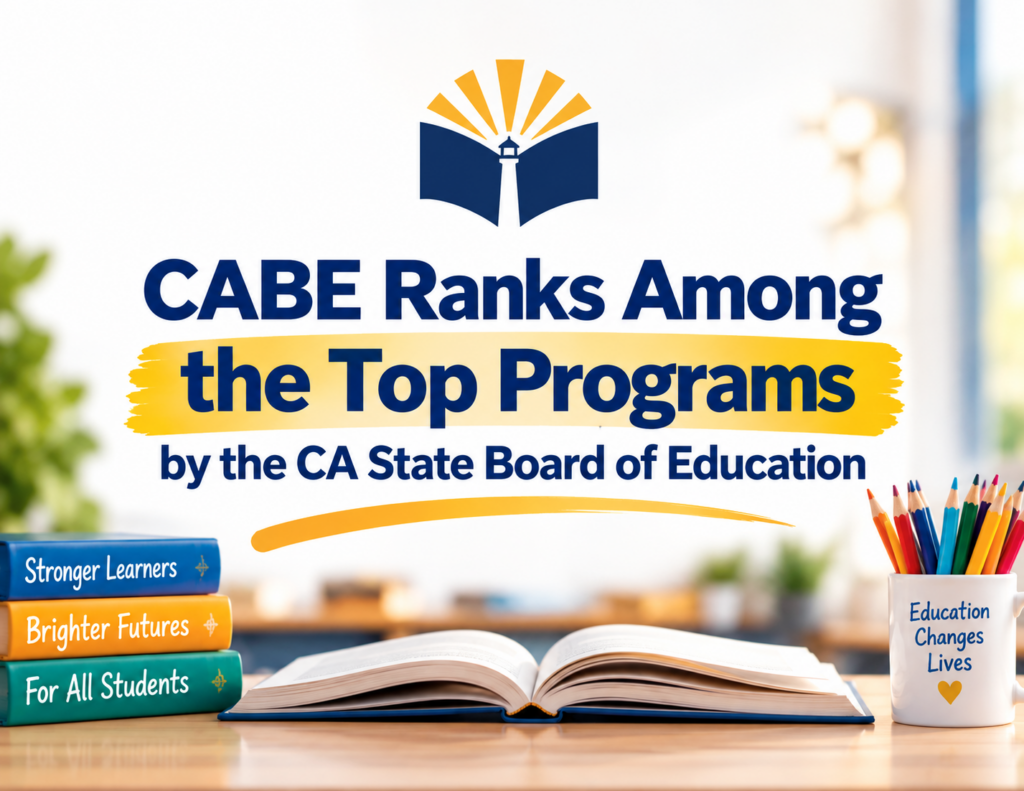
Participants develop a shared understanding of comprehensive literacy and biliteracy instruction grounded in California’s ELA/ELD Framework, English Learner Roadmap, Literacy Roadmap, Dyslexia Guidelines, and MTSS guidance.
Educators examine their current beliefs and practices related to literacy, language, multilingualism, and biliteracy. They consider how instructional decisions influence students’ access to rigorous, meaningful, and language-rich learning.
Participants accomplish:
- Articulate a shared vision for comprehensive literacy and biliteracy
- Examine current instructional practices and areas of alignment
- Understand how language, literacy, culture, and identity influence learning
- Identify school and district priorities for strengthening instructional coherence
2. Applying the BEACONS 6E Instructional Model
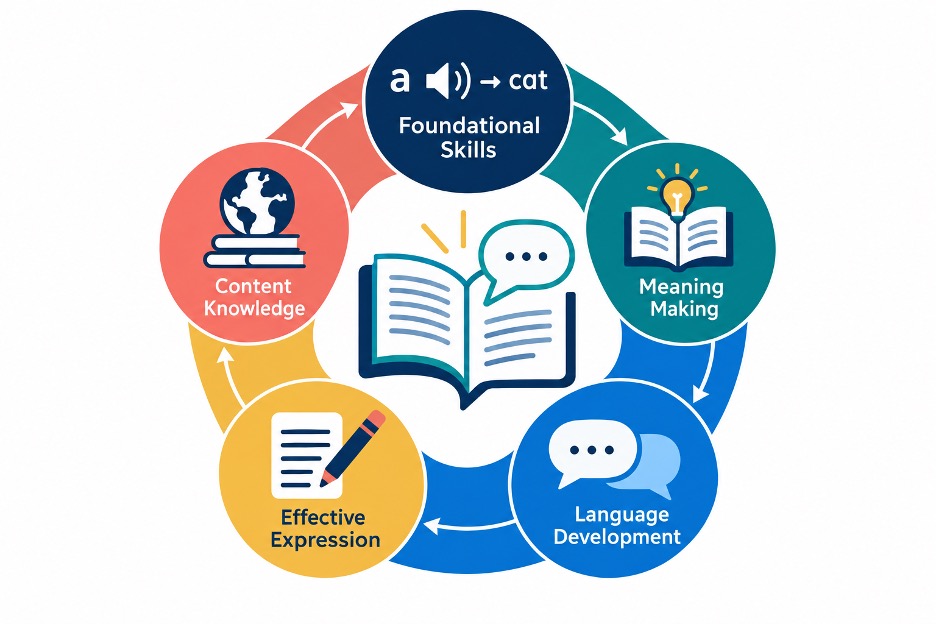
Participants learn to use the BEACONS 6E model—Engage, Explore, Explain, Elaborate, Evaluate, and Extend—to design comprehensive literacy and biliteracy learning experiences.
The model can guide the development of multi-day units or help educators strengthen lessons within their current adopted curriculum. It connects inquiry, explicit instruction, guided practice, meaningful application, assessment, and transfer within one coherent instructional process.
Participants accomplish:
- Understand the purpose of each phase of the 6E model
- Integrate all five ELA/ELD Framework themes (
- Examine the alignment of current instructional practices
- Redesign an existing lesson using the 6E sequence
- Strengthen current curriculum without adding a separate program
3. Teaching Foundational Skills Explicitly and Meaningfully
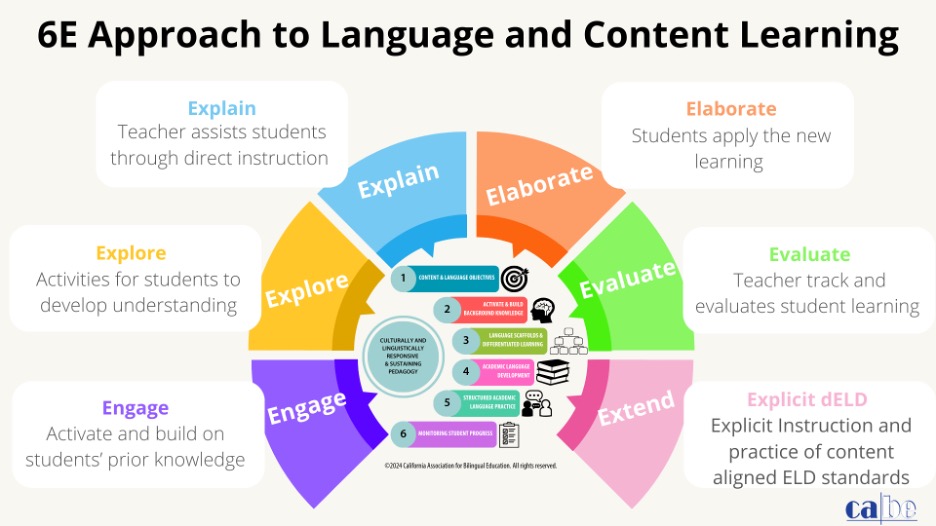
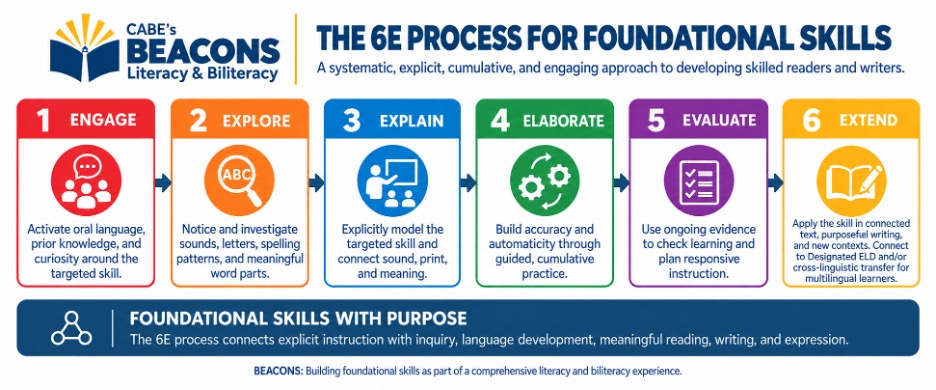
Participants deepen their knowledge of explicit, systematic, and cumulative foundational skills instruction, including print concepts, phonological awareness, phonics, decoding, word recognition, orthographic mapping, and fluency.
BEACONS positions foundational skills as essential tools for comprehension, knowledge building, critical thinking, writing, and effective expression—not as isolated exercises. Educators learn to use inquiry to engage students in noticing how print works, followed by precise teacher explanation, modeling, guided practice, application, and cumulative review.
In biliteracy settings, participants examine the distinct features of English and Spanish, including differences in vowel systems, orthographic transparency, syllable structures, and morphology.
Participants accomplish:
- Strengthen explicit foundational skills instruction
- Connect skills instruction to meaningful reading and writing
- Use diagnostic evidence to plan targeted instruction
- Differentiate foundational skills across English and Spanish
- Align instruction with California’s Dyslexia Guidelines and MTSS
4. Developing Academic Language Through Literacy and ELD
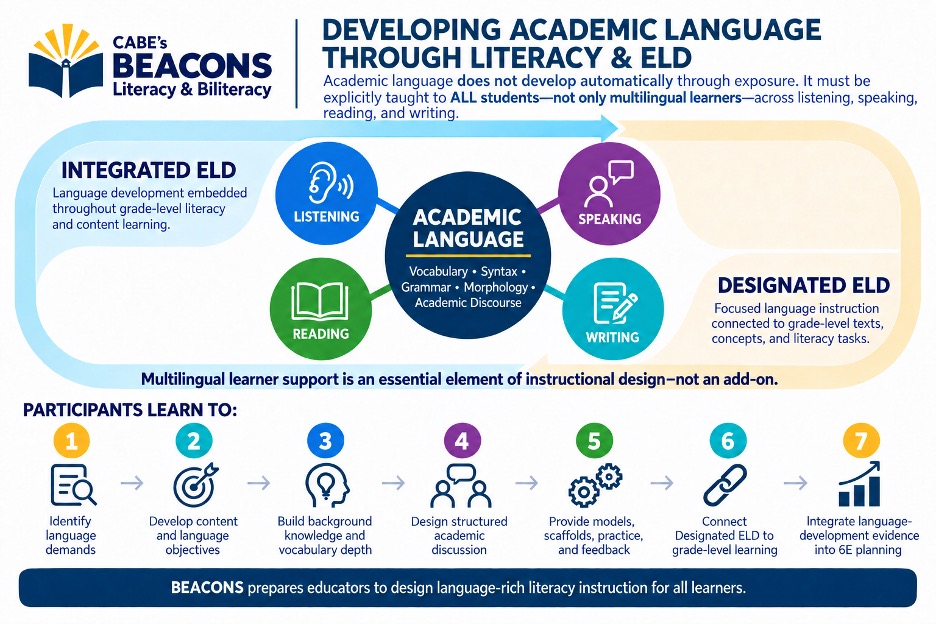
Participants examine why academic language does not develop automatically through exposure and must be explicitly taught across listening, speaking, reading, and writing.
Educators learn to develop vocabulary, syntax, grammar, morphology, and academic discourse within literacy instruction. They strategically embed Integrated and Designated ELD so that multilingual learner support is not an add-on, but an essential element of instructional design.
Participants accomplish:
- Identify the language demands within texts, tasks, and standards
- Develop meaningful content and language objectives
- Build background knowledge and vocabulary depth
- Design structured opportunities for academic discussion
- Provide language models, scaffolds, practice, and feedback
- Connect Designated ELD to grade-level texts, concepts, and literacy tasks
- Integrate evidence of language development into 6E lesson planning
5. Understanding Student Experience Through Multilingual Learner Shadowing
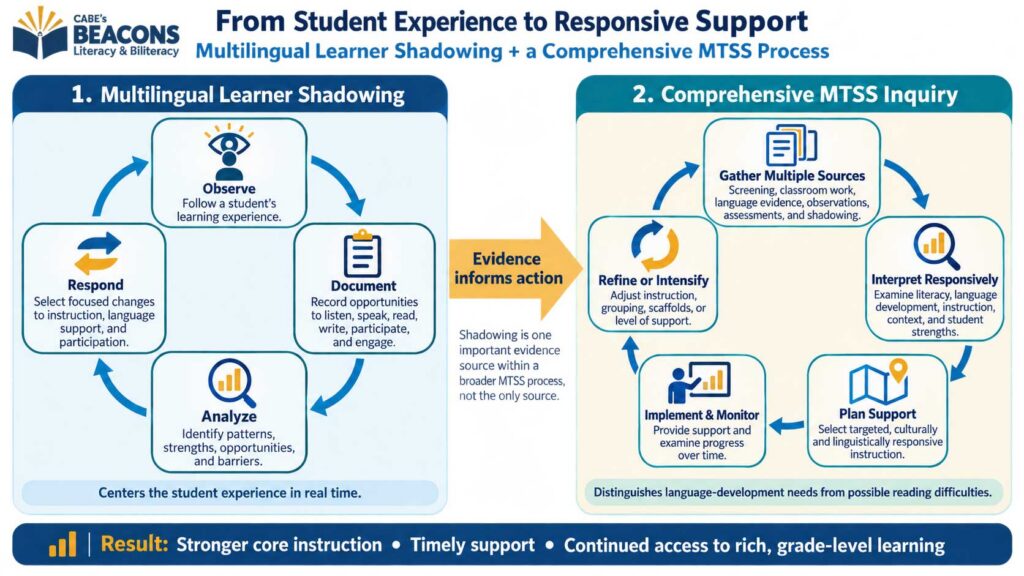
Participants learn to implement Dr. Ivannia Soto’s Multilingual Learner Shadowing Protocol to gather real-time evidence about students’ opportunities to listen, speak, read, write, participate, and engage in learning.
During the first day, participants learn and practice the protocol. During the second day, they analyze findings and translate the evidence into focused instructional responses. Shadowing helps educators identify when students have access to the five ELA/ELD Framework themes and where additional language, literacy, or participation support is needed.
Participants accomplish:
- Conduct the Multilingual Learner Shadowing Protocol
- Document student language and literacy experiences
- Identify opportunities and barriers within classroom instruction
- Connect shadowing findings to 6E lesson adjustments
- Consider ELD, cross-linguistic, and MTSS implications
- Develop a shadowing-informed instructional action plan
CABE is the sole authorized national provider of Dr. Ivannia Soto’s Multilingual Learner Shadowing Protocol.
6. Building a Comprehensive Diagnostic and MTSS System
Participants learn to examine multiple sources of evidence rather than relying on a single assessment or isolated literacy skill. They consider universal screening data, foundational skills assessments, classroom observations, writing samples, language-development evidence, Multilingual Learner Shadowing findings, and teacher knowledge of students.
Educators use these sources together to identify strengths, determine instructional needs, plan targeted support, and reduce the risk of misidentifying multilingual learners within intervention systems.
Participants accomplish:
- Analyze literacy and language evidence comprehensively
- Distinguish language-development needs from possible reading difficulties
- Use diagnostic information to form responsive instructional groups
- Simulate tiered decision-making through student cases and local data
- Plan targeted support without limiting access to rich, grade-level literacy instruction
- Establish recurring inquiry and data-review cycles
7. Strengthening Writing Through Student Work
Participants use student writing as both an instructional resource and a source of diagnostic evidence. They examine how writing reveals students’ comprehension, vocabulary, grammar, morphology, language development, and control of written expression.
In biliteracy settings, educators compare English and Spanish writing to identify cross-language transfer, language-specific patterns, and opportunities for explicit instruction.
Participants accomplish:
- Analyze student writing for literacy and language evidence
- Connect writing to comprehension and knowledge building
- Use mentor texts to teach grammar, morphology, and author’s craft
- Identify transfer patterns across English and Spanish
- Design targeted mini-lessons based on student work
- Strengthen purposeful writing across content areas

8. Applying and Sustaining Learning in the Classroom
Between professional learning sessions, participants apply BEACONS practices in their classrooms, collect student evidence, reflect on implementation, and bring their learning back to the cohort.
Implementation tasks may include redesigning a lesson, teaching a 6E sequence, analyzing student work, conducting shadowing, examining assessment evidence, or testing an academic-language routine.
Participants accomplish:
- Transfer professional learning into classroom practice
- Analyze the effect of instructional decisions on students
- Refine lessons through evidence, reflection, and peer feedback
- Develop shared responsibility for student outcomes
- Build the internal expertise needed to sustain implementation
Optional Job-Embedded Coaching and Implementation Support
Districts can extend the eight-day Core Cohort through coaching and implementation cycles customized to local priorities. Coaching keeps the work connected to classrooms and helps educators move from initial understanding toward increasingly precise and confident implementation.
Observation and Feedback
A CABE coach conducts a pre-conference, observes instruction, gathers evidence aligned with the BEACONS model, and facilitates a reflective, data-informed coaching conversation.
Lesson Modeling and Co-Teaching
A CABE coach collaborates with educators to plan a BEACONS lesson, demonstrates instruction, supports co-teaching, and facilitates a debrief focused on student evidence and instructional decisions.
Collaborative Planning
Grade-level or course teams map current curriculum into the 6E model, strengthen academic language and foundational skills instruction, plan ELD or cross-linguistic connections, and determine appropriate differentiation.
Instructional Rounds
School or district teams visit classrooms using agreed-upon literacy and language indicators. Participants analyze patterns across classrooms and identify system-level strengths, priorities, and next steps.